3/21/2008

Μαξ Ερνστ - Μια σχέση πάθους με τον Αλέξανδρο Ιόλα


Μαξ Ερνστ


Οιδίπους, ελαιογραφία (1922).

Ο Μαξ Ερνστ (Max Ernst, 2 Απριλίου 1891 - 1 Απριλίου 1976) ήταν Γερμανός ζωγράφος και γλύπτης και θεωρείται ένας από τους σημαντικότερους καλλιτέχνες του κινήματος του υπερρεαλισμού αλλά και εν γένει της μοντέρνας τέχνης. Η τέχνη του χαρακτηρίστηκε από πρωτοποριακά και ρηξικέλευθα στοιχεία, με εμφανείς επιρροές από το σουρρεαλιστικό κίνημα. Επιπλέον, ο Μαξ Ερνστ διακρίθηκε για το συνδυασμό διαφορετικών τεχνικών που χρησιμοποίησε, καθώς και από μία διαρκή αναζήτηση νέων μεθόδων σύνθεσης.

Γεννήθηκε στην πόλη Brühl της Γερμανίας, λίγο έξω από την Κολωνία, γιος του δάσκαλου Φίλιπ Ερνστ και της Λουΐζ Κοπ. Το 1909, σε ηλικία 18 ετών, ξεκινά η φοίτησή του στο Πανεπιστήμιο της Βόννης και ειδικότερα στη σχολή Φιλοσοφίας, ωστόσο σε σύντομο χρονικό διάστημα εγκαταλείπει ολοκληρωτικά τις σπουδές του προκειμένου να αφιερωθεί στην τέχνη. Το 1911 γνωρίζεται και συνδέεται φιλικά με τον Όγκουστ Μάκε, ενώ γίνεται και μέλος της μιας εξπρεσιονιστικής ομάδας καλλιτεχνών (Rheinische Expressionisten) στη Βόννη. Τον επόμενο χρόνο εκθέτει έργα του στην γκαλερί Feldman στην Κολωνία. Παράλληλα, έρχεται σε επαφή με το έργο του Σεζάν, του Πικάσσο και του Βαν Γκόγκ και το 1913 ταξιδεύει στο Παρίσι όπου γνωρίζει αρχικά τον ποιητή Γκιγιώμ Απολλιναίρ και αργότερα τον Ζαν Αρπ με τον οποίο θα αναπτύξει ιδιαίτερη φιλία.

Με το ξέσπασμα του Α' παγκοσμίου πολέμου. ο Ερνστ κατατάσσεται στο γερμανικό στρατό. Παρά την στρατιωτική του θητεία, εξακολουθεί να ζωγραφίζει και το 1916 συμμετέχει σε έκθεση στο Βερολίνο. Μετά το τέλος του πολέμου, επιστρέφει στην Κολωνία το 1918, όπου πραγματοποιεί τα πρώτα του έργα κολάζ ενώ συμμετέχει ενεργά και στη σύσταση της ντανταϊστικής ομάδας στην Κολωνία. Το 1921 εκθέτει για πρώτη φορά έργα του στο Παρίσι και την ίδια περίπου περίοδο αναμειγνύεται στις δραστηριότητες των Γάλλων υπερρεαλιστών. Καταγράφονται και αρκετές συνεργασίες του με άλλους υπερρεαλιστές καλλιτέχνες, όπως τον Πωλ Ελυάρ, τον Χουάν Μιρό αλλά και τον σκηνοθέτη Λουίς Μπουνιουέλ, με τον οποίο συνεργάζεται για την ταινία Χρυσή Εποχή όπου υποδύεται και έναν μικρό ρόλο.

Το 1926 εκδίδει το έργο Φυσική Ιστορία χρησιμοποιώντας την τεχνική του φροτάζ και τρία χρόνια αργότερα εκδίδει το πρώτο μυθιστόρημα-κολάζ με τίτλο Η Γυναίκα Με Τα 100 Κεφάλια. Το 1931 εκθέτει για πρώτη φορά στην Αμερική, στη Julian Levy Gallery της Νέας Υόρκης και με την έναρξη του Β' παγκοσμίου πολέμου αναζητά και πάλι καταφύγιο στις Ηνωμένες Πολιτείες, όπου κατορθώνει να εγκατασταθεί χάρη στη βοήθεια του αμερικανού δημοσιογράφου Varian Fry, το 1941. Στην Αμερική, συνδέεται με τον Μαρσέλ Ντυσάν και θεωρείται πως αποτελεί κατά κάποιο τρόπο επιρροή των καλλιτεχνών του αφηρημένος εξπρεσιονισμού.

Ο Ερνστ επιστρέφει στην Ευρώπη το 1950 και το 1954 του απονέμεται το πρώτο βραβείο ζωγραφικής στη Μπιενάλε της Βενετίας. Μια σημαντική αναδρομική έκθεση με έργα του παρουσιάζεται στο Μουσείο Guggenheim της Νέας Υόρκης. Πεθαίνει τον επόμενο χρόνο στο Παρίσι.


Max Ernst


Max Ernst

Max Ernst and Dorothea Tanning in 1948
Born April 2, 1891(1891-04-02)
Brühl, Germany
Died April 1, 1976 (aged 84)
Paris, France
Nationality German
Field painting, sculpture, poetry
Movement Dada, Surrealism

Max Ernst (2 April 1891 - 1 April 1976) was a German painter, sculptor, graphic artist, and poet, considered one of the chief representatives of Dadaism and Surrealism.

Contents

[hide]

Early life

Max Ernst was born in Brühl, Germany, near Cologne. In 1909, he enrolled in the University at Bonn to study philosophy but soon abandoned the courses. He began painting that year, but never received any formal artistic training.[1]

Max Ernst in 1909
Max Ernst in 1909

During World War I he served in the German army, which was a momentous interruption in his career as an artist. He stated in his autobiography, "Max Ernst died the 1st of August, 1914."

Dada & Surrealism

After the war, filled with new ideas, Ernst, Jean Arp and social activist Alfred Grünwald, formed the Cologne, Germany Dada group. In 1918 he married the art historian Luise Straus - a stormy relationship that would not last. The couple had a son who was born in 1920, the artist Jimmy Ernst. (Luise died in Auschwitz in 1944.[2]) In 1919 Ernst visited Paul Klee and created paintings, block prints and collages, and experimented with mixed media.

In 1922, he joined fellow Dadaists André Breton, Gala, Tristan Tzara, Paul Éluard at the artistic community of Montparnasse.[1] Constantly experimenting, in 1925 he invented a graphic art technique called frottage, which uses pencil rubbings of objects as a source of images.

Max Ernst, Ubu Imperator, (1921), Musee National d'Art Moderne, Centre Pompidou, Paris, France

The next year he collaborated with Joan Miró on designs for Sergei Diaghilev. With Miró's help, Ernst pioneered grattage in which he troweled pigment from his canvases. He also explored with the technique of decalcomania which involves pressing paint between two surfaces.[3]

Max Ernst, Europe After the Rain II, (1940-1942)

Ernst developed a fascination with birds that was prevalent in his work. His alter ego in paintings, which he called Loplop, was a bird. He suggested this alter-ego was an extension of himself stemming from an early confusion of birds and humans. He said his sister was born soon after his bird died. Loplop often appeared in collages of other artists' work, such as Loplop presents André Breton. Ernst drew a great deal of controversy with his 1926 painting The Virgin Chastises the infant Jesus before Three Witnesses: André Breton, Paul Éluard, and the Painter.[4] In 1927 he married Marie-Berthe Aurenche, and it is thought his relationship with her may have inspired the erotic subject matter of The Kiss and other works of this year.[5] In 1930, he appeared in the film "L'age d'or" directed jointly by Salvador Dali and Luis Bunuel. Ernst began to make sculpture in 1934, and spent time with Alberto Giacometti. In 1938, the American heiress and artistic patron Peggy Guggenheim acquired a number of Max Ernst's works which she displayed in her new museum in London.

World War II and after

Max Ernst, L'Ange du Foyer, (1937)

With the outbreak of World War II, Ernst was arrested by French authorities as a "hostile alien". Thanks to the intercession of Paul Eluard, and other friends including the journalist Varian Fry he was discharged a few weeks later. Soon after the Nazi occupation of France, he was arrested again, this time by the Gestapo, but managed to escape and flee to America with the help of Guggenheim.[1] He left behind his lover, Leonora Carrington, and she suffered a major mental breakdown. Ernst and Guggenheim arrived in the United States in 1941 and were married the following year. Along with other artists and friends (Marcel Duchamp and Marc Chagall) who had fled from the war and lived in New York City, Ernst helped inspire the development of Abstract expressionism.

His marriage to Guggenheim did not last, and in Beverly Hills, California in October of 1946, in a double ceremony with Man Ray and Juliet Browner, he married Dorothea Tanning. The couple first made their home in Sedona, Arizona. In 1948 Ernst wrote the treatise Beyond Painting. As a result of the publicity, he began to achieve financial success.

In 1953 he and Tanning moved to a small town in the south of France where he continued to work. The City, and the Galeries Nationales du Grand-Palais in Paris published a complete catalogue of his works.

Ernst died on 1 April 1976, in Paris.[1] He was interred there at the Père Lachaise Cemetery


Ernst sculpture on display at the Louisiana Museum of Modern Art in Denmark

Ernst sculpture on display at the Louisiana Museum of Modern Art in Denmark
Max-Ernst-Museum Brühl

Ernst in modern culture

  • Many of Ernst's works from Une Semaine de Bonté are used in albums by American rock group The Mars Volta, and Barefoot In The Head, a collaboration between guitarist Thurston Moore and saxophonists Jim Sauter and Don Dietrich of Borbetomagus, features a collage from this same book.
  • The American rock group Mission of Burma titled two songs after the artist: "Max Ernst" was the b-side of their first 1978 single (now included on the CD of Signals, Calls and Marches), mentioning two of Ernst's paintings (The Blessed Virgin Chastises the Infant Jesus and Garden Airplane-Trap) and ending with the words "Dada dada dada ..." repeated many times and distorted via tape loop; their 2002 album OnOffOn features "Max Ernst's Dream".


3/20/2008

Niki de Saint Phalle-Αλέξανδρος Ιόλας-Jean Tingueli


Niki de Saint Phalle

Who was Niki de Saint Phalle?

Niki de Saint Phalle, née Catherine Marie-Agnes Fal de Saint Phalle (October 29, 1930 - May 21, 2002) was a French sculptor, painter, and film maker

The Early Years

De Saint Phalle was born in Neuilly-sur-Seine in Paris to Jeanne Jacqueline (née Harper) and Andre Marie-Fal de Saint Phalle, a banker. After being wiped out financially during the Great Depression, the family moved from France to the United States in 1933. During her teens, she was a fashion model; at the age of sixteen she made the cover of Life magazine (September 26, 1949), and later the November 1952 cover of the French Vogue magazine. At eighteen, de Saint Phalle eloped with author Harry Mathews, whom she had known since the age of twelve, and moved to Cambridge, Massachusetts. While her husband studied music at Harvard University, de Saint Phalle began to paint, experimenting with different media and styles. Their first child, Laura, was born in 1951.

De Saint Phalle rejected the staid, conservative values of her family, which dictated domestic positions for wives and particular rules of conduct. However, after marrying young and giving birth to two children, she found herself living the same bourgeois lifestyle that she had attempted to reject; the internal conflict led to her to suffer a nervous breakdown. As a form of therapy, she was encouraged to start painting.

From the about to open “Master Printers” exhibition at the Municipal Art Gallery of the City of Los Angeles.


While in Paris, de Saint Phalle was introduced to the American painter Hugh Weiss who became both her friend and mentor, encouraging her to continue painting in her self-taught style. She subsequently moved to Deya, Majorca, Spain where her son Philip was born in May of 1955. While in Spain, de Saint Phalle read the works of Proust and visited Madrid and Barcelona where she discovered and was deeply affected by the work of Antonio Gaudí. Gaudí’s influence opened many previously unimagined possibilities for de Saint Phalle regarding the use of diverse material and objet-trouvés as structural elements in sculpture and architecture. De Saint Phalle was particularly struck by Gaudí’s “Park Güell” which convinced her to one day create her own garden work that would combine both art and nature. Saint Phalle continued to paint, particularly after her family relocated to Paris in the mid-1950s. Her first art exhibition was held in 1956 in Switzerland where she displayed naïve style oil paintings. She then moved onto collage work that often featured objects of violence, such as guns and knives.

Do you like my new outfit? on Flickr

by Niki de Saint Phalle
Eye on Europe: Prints, Books & Multiples/1960 to Now

MoMA October 15, 2006–January 1, 2007

The Nanas

After the “Shooting paintings” came a period when she explored the various roles of woman. She made life size dolls of women, such as brides and mothers giving birth. They were usually dressed in white. They were primarily made of polyester with a wire framework. They were generally created from papier mâché.

Inspired by the pregnancy of her friend Clarice Rivers, the wife of American artist Larry Rivers, she began to use her artwork to consider archetypal female figures in relation to her thinking on the position of women in society. Her artistic expression of the proverbial everywoman were named ‘Nanas’.


The first of these freely posed forms, made of papier-mâché, yarn, and cloth were exhibited at the Alexander Iolas Gallery in Paris in September of 1965. For this show, Iolas published her first artist book that includes her handwritten words in combination with her drawings of ‘Nanas’. Encouraged by Iolas, she started a highly productive output of graphic work that accompanied exhibitions that included posters, books and writings.

In 1966, she collaborated with fellow artist Jean Tinguely and Per Olof Ultlvedt on a large scale sculpture installation, “hon-en katedral”. for Moderna Museet, Stockholm, Sweden. The outer form of “hon” is a giant, reclining ‘Nana’, whose internal environment is entered from between her legs. The piece elicited immense public reaction in magazines and newspapers throughout the world. The interactive quality of the “hon” combined with a continued fascination with fantastic types of architecture insensifies her resolve to see her own architectural dreams realized. During the construction of the “hon-en katedral,” she met Swiss artist Rico Weber, who became an important assistant and collaborator for both de Saint Phalle and Jean Tinguely. During the 1960s, she also designed decors and costumes for two theatrical productions: a ballet by Roland Petit, and an adaptation of the Aristophanes play “Lysistrata.”

The Tinguely Museum (Basel) with an exhibition of Niki de Saint Phalle and Jean Tinguely called l’Art et l’amour

Her life with Jean Tinguely

In 1955 de Saint Phalle met Jean Tinguely and his wife, Eva Aeppli. She asked Tinguely to weld the armature for her first sculpture. In 1960, de Saint Phalle divorced her husband, writer Harry Mathews. That same year, Jean Tinguely and Eva Aeppli also divorced. De Saint Phalle and Tinguely subsequently moved into the Impasse Ronsin where they shared the same studio and lived surrounded by other artists, including Constantin Brancusi. It was in this period that Marcel Duchamp introduced the pair to the Spanish surrealist Salvador Dalí. De Saint Phalle later traveled to Spain with Tinguely in order to attend a celebration honoring Dalí; while there, the pair created a life-sized exploding bull with plaster, paper and fireworks for the arena at Figueras. In 1963, they bought an old country inn outside of Paris to serve as both their home and studio, l’Auberge du Cheval Blanc in Soisy-sur-Ecole, some 50 kilometers south of Paris. She married Jean Tinguely on 15 July 1971 acquiring Swiss citizenship.

The Tarot Garden

Influenced by Gaudí´s Parc Güell in Barcelona, and the garden in Bomarzo, de Saint Phalle decided that she wanted to make something similar; a monumental sculpture park created by a woman. In 1979, she acquired some land in Garavicchio, Tuscany, about 100 km north-west of Rome along the coast.


The garden, called Giardino dei Tarocchi in Italian, contains sculptures of the symbols found on Tarot cards. The garden took many years, and a considerable sum of money, to complete. It opened in 1998, after more than 20 years of work. She then went on at the royal palace and made a painting and gave it to the queen, evey year she did this and that is how she became famous.


Jaen Tinguely-Alexander Iolas-Niki de Saint Phalle

1925

Born on May 22 in Fribourg.
Mother and child move from Bulle to Basel in July 1925.

1931 - 1940

Attends schools in Basel.

1941 - 1944

Apprenticeship as a decorator.

1944

Attends courses at the School of Arts and Crafts in Basel.

From 1947

One of the followers of the Basel anarchist Heiner Koechlin.

October 1952

Moves to France with his wife Eva Aeppli.

May 1954

Opens his first exhibition at Galerie Arnaud in Paris.

1955

At the beginning of the year Tinguely moves into a studio in the Impasse Ronsin; his neighbours are sculptor Constantin Brancusi and other artists.
Shows his Relief Méta-mécanique sonore in an exhibition at Galerie Samlaren in Stockholm.

1955 - 1956

Meets Niki de Saint Phalle and Yves Klein.

1958

Exhibits Mes étoiles – Concert pour sept peintures at Galerie Iris Clert in July.
Shows the installation “Vitesse pure et stabilité monochrome” in the same gallery in November together with Yves Klein.

March 1959

Scatters copies of the manifesto “Für Statik” (For statics) from an airplane over Düsseldorf.

July 1959

Exhibition “Méta-Matics de Jean Tinguely” at Galerie Iris Clert in Paris.

November 1959

“Cyclo-Matic” Evening at the ICA (Institute of Contem- porary Arts) in London, a happening with racing cyclists and drawing machines.

March 1960

“Homage to New York”, happening with a self-destructing machine sculpture in the garden of the Museum of Modern Art in New York.

October 1960

The group “Nouveaux Réalistes” is founded in Paris with Arman, Francis Dufrêne, Raymond Hains, Yves Klein, Pierre Restany, Jacques de Villeglé, Martial Raysse and Daniel Spoerri.

September 1961

“Étude pour une fin du monde No. 1”, a happening with rockets and other fireworks at the Louisiana Museum, Humlebaek, Denmark.

March 1962

“Study for an End of the World No. 2”, another sculpture group that self-destructs in the presence of an audience in the desert near Las Vegas, Nevada, USA.

Winter 1963 - 1964

Creation of the large sculpture “Heureka” for the Expo 64 in Lausanne.

Spring 1966

Creation of “Hon” in collaboration with Niki de Saint Phalle and Per Olof Ultvedt at the Moderna Museet in Stockholm.

1967

Presents two works at the World Fair 67 in Montreal; creates “Requiem pour une feuille morte” for the Swiss pavilion, and “Le Paradis fantastique” together with Niki de Saint Phalle for the French pavilion.

Christmas 1968

Takes up residence in Switzerland in an old inn he acquires in Neyruz, Canton of Fribourg.

1970

Construction begins in Milly-la-Forêt on “Le Cyclop”, a giant walk-in sculpture created in collaboration with Bernhard Luginbühl, Larry Rivers, Niki de Saint Phalle, Daniel Spoerri and others. Work is carried out with the aid of Tinguely's assistants Josef Imhof and Rico Weber.

November 1970

“La Vittoria”: in front of Milan Cathedral, Tinguely burns a giant golden phallus on the occasion of the festival celebrating the 10th anniversary of the “Nouveaux Réalistes”.

1971 - 1973

Creation of the “Grosse Spirale” or “Doppel-Helix” in the courtyard of the Basel Institute for Immunology of F. Hoffmann-La Roche Ltd.

1973 - 1975

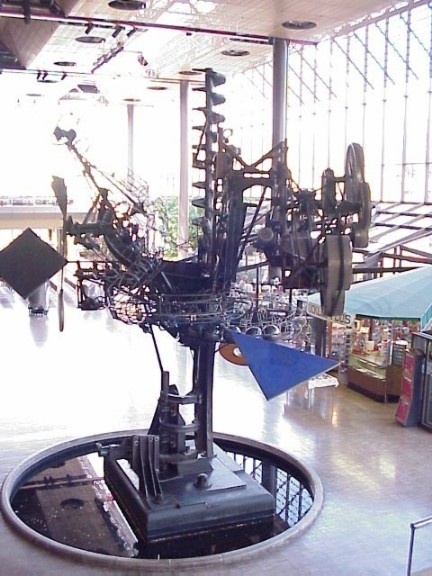
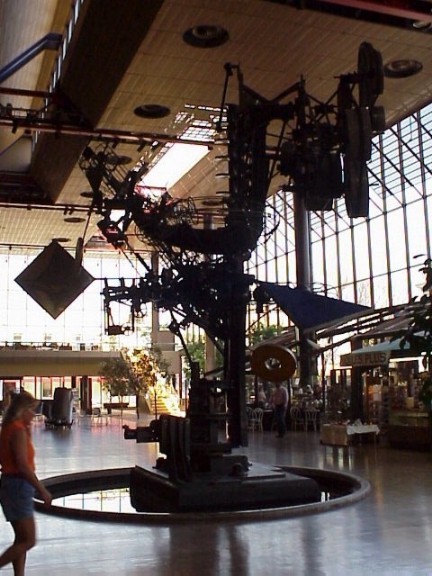
Tinguely constructs the monumental sculpture “Chaos No. 1” in the Civic Mall, Columbus, Indiana, USA.

November 1976

“Débriscollages” exhibition at Galerie Bischofberger in Zurich, in which visitors are encouraged to produce their own work of art.

May 1977

For the opening of the Centre Georges Pompidou in Paris, Jean Tinguely, Bernhard Luginbühl and Niki de Saint Phalle create the installation “Le Crocrodrome de Zig & Puce”. Inside it, Daniel Spoerri sets up a “Musée sentimental”.

June 1977

Dedication of the “Fasnachtsbrunnen” in Basel.

September 1978

“Méta-Harmonie I” is created for the Hammer exhibition in Basel.

May 1979

“Klamauk”, a sound sculpture mounted on a tractor, and “Méta-Harmonie II” are shown for the first time in a more important show at the “Tinguely – Luginbühl” exhibition at the Städel, Frankfurt.

July 1981

Exhibition at the Abbey of Sénanque. Tinguely exhibits skull sculptures for the first time.

1982 - 1983

Retrospectives in Zurich (Kunsthaus), London (Tate Gallery), Brussels (Palais des Beaux-Arts) and Geneva (Musée d’Art et d’Histoire). The altarpiece “Cenodoxus” is one of the key works in the exhibitions in Zurich and Geneva.

March 1983

Dedication of the Fontaine Igor Strawinsky in Paris, created in collaboration with Niki de Saint Phalle.

February – April 1984

Creation of a sculpture called “Pit-Stop” in Rungis near Paris commissioned by Régie Renault, composed of elements from Formula 1 racing cars.

June 1984

Dedication of the “Fontaine Jo Siffert”, a gift of Jean Tinguely to the city of Fribourg.
Tinguely creates “Meta-Harmonie III – Pandämonium” for the Seibu Museum in Japan.

1985

Creation of “Méta Harmonie IV – Fatamorgana” in an abandoned factory building of Von Roll Ltd. in Olten for the exhibition in the Kunsthalle of the Hypo-Kulturstiftung in Munich.

Autumn 1986

Tinguely creates his “Mengele-Totentanz,” using charred beams, burnt agricultural machinery, household appliances and animal skulls from a farmhouse in Neyruz that burned to the ground.

1987

Creation of the huge, walk-in “Grosse Méta Maxi-Maxi Utopia” in a factory building of Von Roll Ltd. in Klus. This is shown in the retrospective in Venice (Palazzo Grassi). The exhibition continues to Turin (Promotrice delle Belle Arti), Paris (Musée national de l’art moderne in the Centre Georges Pompidou). In Paris, Tinguely exhibits for the first time “Dernière Collaboration avec Yves Klein” and the sculpture group “Les Philosophes”.

January 1988

Purchase of the former bottle factory La Verrerie in the Canton of Fribourg to serve as a studio.

March 1988

Dedication of the Fontaine de Château-Chinon – commissioned by the President of France, François Mitterrand – created in collaboration with Niki de Saint Phalle.

1990

A Tinguely exhibition is held at the Tretyakov Gallery in Moscow. The expanded Moscow exhibition is shown in 1991 at the Musée d'Art et d'Histoire in Fribourg. Tinguely also shows at these exhibitions his “Rétable de l’abondance occidentale et du mercantilisme totalitaire”.

1991

Creation of “La Cascade“, a large hanging sculpture, in Charlotte, North Carolina, USA.
At the ART Basel exhibition, presentation of “Kulturgüter- zug”, an installation by Jean Tinguely in collaboration with Eva Aeppli, Bernhard and Iwan Luginbühl, Jim Whiting, Milena Palakarkina, Daniel Spoerri and Ben Vautier.

June 1991

The large lamp sculpture “Luminator” is built for the inauguration in an empty exhibition hall.

Summer 1991

“Nachtschattengewächse”, the last exhibition personally installed by Tinguely, is held at the Kunsthaus, Vienna.

1991

On August 30, 1991, Jean Tinguely dies at the Inselspital, Berne.
1955, Bezug des Atelier
1955, Moves into Atelier

1955, Relief "Méta-mécanique sonore II"

1959, Manifest "Für Statisktik"
1959, Manifesto "Für Statik"

1959, "Cyclo-Matic"-Abend im ICA
1959, "Cyclo-Matic" evening in the ICA

1960, "Homage to New York"

1962, "Study for an End of the World No. 2"

1963 - 64, Grossskulptur "Heureka"
1963 - 64, Sculpture "Heureka"

1967, Arbeiten für die Weltausstellung
1967, Works for the World Fair

1968, Wohnsitznahme in der Schweiz
1968, Residence in Switzerland

1970, Baubeginn von "Le Cyclop"
1970, Starts on "Le Cyclop"

1979, "Klamauk"
1979, "Klamauk"

1984, "Pit-Stop"
1984, "Pit-Stop"

1985, in der Von Roll Fabrikhalle
1985,In the Von Roll plant

1970, "Méta Harmonie IV - Fatamorgana"

1987, "Grosse Méta Maxi-Maxi Utopia"

1988, "Fontaine de Château-Chinon"
1988, "Wittgenstein, Philosoph"

1990, Tinguely-Ausstellung in der Tretjakov-Galerie
1990, Tinguely exhibition at the Tretjakov Galery

The Swiss sculptor Jean Tinguely was born in Fribourg on 22 May 1925. After going to school in Basle, he began an apprenticeship as a shop-window decorator in a department store in 1940. He then studied at the Kunstgewerbeschule in Basle from 1941 to 1945, a period during which he discovered the art of Schwitters and Klee as well as becoming an enthusiastic fan of the Bauhaus. Tinguely began experimenting with movement in space in 1944 with his machine-like sculptures by equipping them with electric motors and making them spin around at high speed. He moved to Paris in 1951, where he participated in Robert Rauschenberg's international happenings and associated with the casual artist group 'Nouveaux Réalistes', exhibiting works in their exhibitions. He had his first one-man exhibition three years later, in 1954, at the Galerie Arnaux. Tinguely's fantasy machines with pre-programmed elements of chance, the so-called 'Métamatics', are quite spectacular. They are machines producing drawings, or self-destructive machines. His welded iron constructions represent ironic attacks on the purpose of the era of technology. Tinguely exhibited works at the Biennale in Paris in 1959 and associated himself with the group ZERO. The artist's international fame came around the mid-1960s, if not earlier. He showed works at the documenta 3, 4 and 6 in Kassel between 1964 and 1977. Tinguely married the artist Niki de Saint-Phalle, a close friend of his, in 1961. Together, they installed the climbable female sculpture 'Hon' at the Moderna Museet, Stockholm in 1966. In the same year he participated in the exhibition 'The Machine' at the Museum of Modern Art, New York. One year later he was present at the World Exhibition in Montreal. His 'Machines' were once again shown at the Museum of Modern Art, New York, in 1968 in the exhibition 'Dada, Surrealism and their Heritage'. The Museum of Contemporary Art in Chicago organised a retrospective exhibition in the same year and there was a large touring retrospective exhibition in 1972/73 which started at the Kunsthalle in Basle. Tinguely never ceased working, even in his old age. In 1980/81 he created the fountain 'La Fontaine Stravinsky' in Paris together with Niki de Saint Phalle. During the 1980s Tinguely realised several major projects, et al. exhibitions, sculpture groups and fountains. His works conquered the world. Jean Tinguely died in Bern on 20 August 1991.


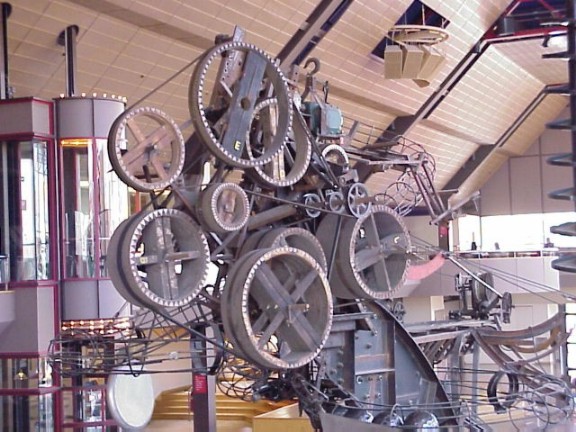
Chaos I by Jean Tinguely

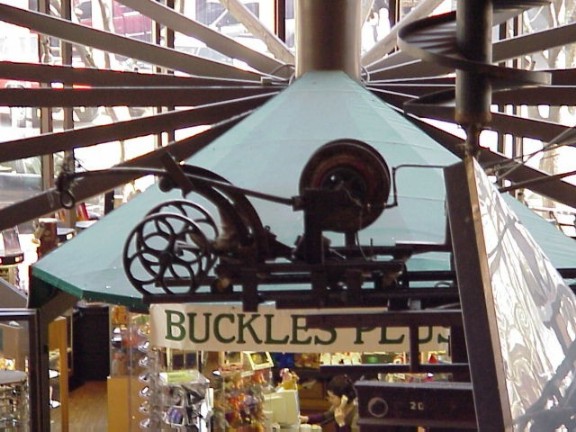
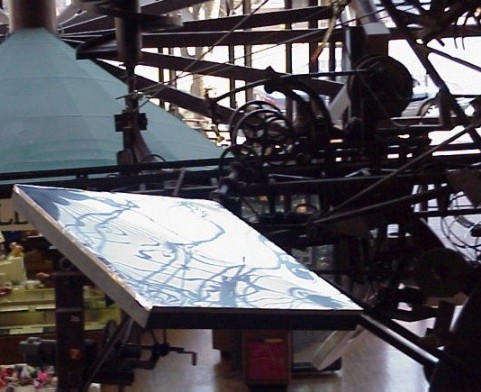
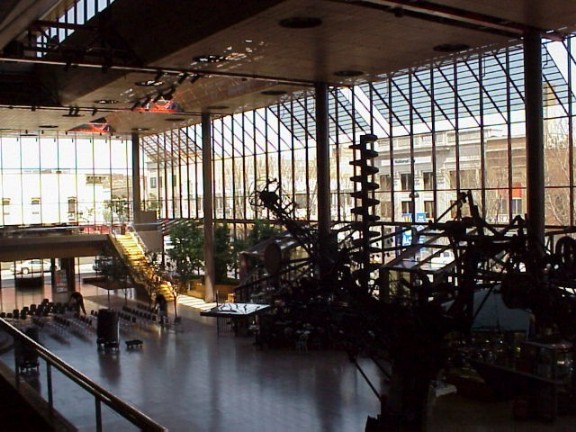
Chaos Sculpture by Jean TinguelyWeighing almost seven tons and standing 30 feet high, Chaos I is the centerpiece of The Commons, a downtown civic mall that is attached to a small shopping complex. At first glance it appears that the “in motion” sculpture is a whirring, clanging, clanking hunk of junk! A closer look, however, reveals the sense of humor and imagination of its creator, Swiss artist, Jean Tinguely.
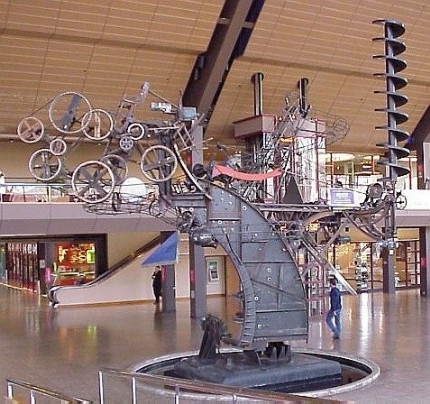
Chaos I is an artistic and engineering wonder, and kids and adults alike enjoy watching its different movements. Giant lollipop shapes twirl, gears move, and big, metal balls slowly climb up a shaft, drop down and roll through an airy, wire tunnel. There’s so much going on at one time, that it’s impossible to catch it all. A moat, of sorts, surrounds the sculpture, and people enjoy tossing pennies into the water and making wishes. Now and then, the money is collected and given to charity.

The Commons features a stage and a large, open area that is used for a variety of community activities. The architect, Cesar Pelli, recommended that a major work of art be placed in the space, and Mr. Tinguely was chosen to create a sculpture. Mr. and Mrs. J. Irwin Miller and his sister, Mrs. Robert Tangeman, gave the public area and sculpture to the city in 1974.

The artist liked to create sculptures from salvaged metal, and most of the materials for Chaos I were purchased at the Kroot Corporation in Columbus. The company, which has been in business for more than 100 years, is a scrap metal recycling firm. Much of Chaos I was created in the old powerhouse building, now the Senior Citizens Center. When it was time to put it together, the sculpture parts were moved to The Commons.

Several local craftsmen worked under Mr. Tinguely’s direction to build the sculpture. One day someone who was assembling pieces at the top removed a boot in order to rest his foot. He placed the boot on the sculpture, and when Mr. Tinguely saw it there, he asked him to leave it as part of the art! A year or so later the boot was removed, but it was replaced when the public noticed it missing and demanded its return. The artist, who had a great sense of humor, would be pleased.

Jean Tinguely’s work was introduced in America in 1960 at the Museum of Modern Art in New York City. “Homage to New York” was a kinetic or “in motion” sculpture that was supposed to destroy itself. Something went wrong, however, and a few New York City firemen helped finish it off!

In speaking about his work, the artist said, “Life is movement. Everything transforms itself, everything modifies itself ceaselessly, and to try to stop it . . . seems to me a mockery of the intensity of life." Mr. Tinguely was very pleased with Chaos I, and it was one of his favorite sculptures. It is well loved by Columbus children, too.

Learn more about our buildings and their architects at the Columbus Visitors Center, and visit the Jean Tinguely Museum to see more of the famous sculptor’s work.

Please Note: After a big New Year's Eve party, The Commons was closed to the public on January 1, 2008. A new building, which will include the Chaos I sculpture, will take its place in two or three years.


Click on any of the small images below for a larger version.