3/17/2008

William N. Coppey-Aλέξανδρος Ιόλας-Βιογραφικό

WILLIAM N. COPLEΥ

April 18 - May 26, 2007


Biography

Exhibition Press Release Biography

1919 born in New York City, educated at Phillips Academy and Yale University
1942-46 Military service in Africa and Italy
1947-48 directs Copley Galleries in Beverly Hills, CA (with John Ployardt)
1947 begins to paint
1951 moves to Paris
1963 returns to New York City
1992 moves to Key West, Florida where he lives until his death in May 1996

Selected Solo Exhibitions

2007 Linn Lühn, Cologne
2006 Nolan/Eckman Gallery, New York
2005 Galerie Onrust, Amsterdam
2004 Galerie Daniel Blau, Munich
2003 Nolan/Eckman Gallery, New York
Easy to Read Storybook, BAWAG Foundation, Vienna
2002 Drawings 1956-1994 Galerie Fred Jahn, Munich
2001 Nolan/Eckman Gallery, New York
Bonnefanten Museum, Maastricht, the Netherlands
2000 Phyllis Kind Gallery, New York
1999 Galerie Fred Jahn, Munich
L.A.C., Lieu d'Art Contemporain, Sigean, France
1998 Galerie Lelong, Zurich
Galerie Onrust, Amsterdam
Nolan/Eckman Gallery, New York
1997 Ulmer Museum, Ulm
Galerie Fred Jahn, Munich
1996 Nolan/Eckman Gallery, New York, NY
1995 Kestner-Gesellshaft, Hamburg (Retrospective)
Galerie Lelong, Zurich
1994 Nolan/Eckman Gallery, New York, NY
1993 Galerie Zell am See, Schloss Rosenberg, Austria
Haus Am Lutzowplatz, Berlin, Germany
1991 David Nolan Gallery, New York
Galerie Fred Jahn, Munich
Phyllis Kind Gallery, New York & Chicago
1990 Galerie Klewan, Munich, Germany
Phyllis Kind Gallery, Chicago
1988 Galerie 1900/2000, Paris
1987 Kewenig Galerie, Frechen-bachem, Germany
Phyllis Kind Gallery, New York
1986 The Tomb of the Unknown Whore, installation at Workspace, New Museum of Contemporary Art, New York
1985 Phyllis Kind Gallery, New York
The Quay Gallery, San Francisco
1983 Post-Raphaelite Painting by William N. Copley, Reinhard Onnasch Ausstellungen, Berlin, Germany
Phyllis Kind Gallery, New York
1982 Phyllis Kind Gallery, Chicago
1981 CPLY, Galerie Klewan, Munich Kunstler Werkstatt, Lothringerstrasse, Munich
Phyllis Kind Gallery, New York
Alexander Iolas Gallery, New York
1980-81 Traveling Retrospective: Badischer Kunstverein e.v., Karlsruhe
Stedelijk Van Abbemuseum, Eindhoven
Musee National D'Art Moderne, Centre Georges Pompidou, Paris
Kunsthalle Bern, Bern
1980 Alexander Iolas Gallery, New York
1979 CPLY: Reflections on a Past Life, Institute for the Arts, Rice University, Houston
CPLY/X-Rated Paintings, Galerie Fassbender, Munich
1978-79 Variations on a Theme by Francis Picabia, David Stuart Galleries, Los Angeles
Alexander Iolas Gallery, New York
Galerie Rudolf Zwirner, Cologne, Germany
1978 Galerie Fassbender, Munich
Galerie Springer, Berlin
Alexander Iolas Gallery, New York
1977 Phyllis Kind Gallery, Chicago
1976 Washington Art Association, Washington, CT
David Stuart Galleries, Los Angeles
Alexander Iolas Gallery, New York
1974 Western Songs, Onnasch Galerie, Cologne
Onnasch Gallery, New York
Moore College of Art, Philadelphia
CPLY/X-Rated, New York Cultural Center, New York
1973 Gallerie Il Fauna, Turin
1972 Gallery Suzanne Saxe, San Francisco
Galerie Iolas, Milan & Paris
Alexander Iolas Gallery, New York
David Stuart Galleries, Los Angeles
1971 Nouns, Alexander Iolas Gallery, New York
1970 Galerie Aspects, Brussels
Galerie Neuendorf, Cologne
Galerie Springer, Berlin
1969 Ballads, Galerie Iolas, Geneva
Gallerie de Leone, Venice
Merida Gallery, Louisville, KY
1967 Bodley Gallery, New York
Homage to Robert W. Service, Alexander Iolas Gallery, New York
Galerie Iolas, Paris
1966 Copley - Entertainment for Men, Stedelijk Museum, Amsterdam
Galerie Iolas, Paris
Alexander Iolas Gallery, New York
1965 Allan Frumkin Gallery, Chicago
Southwestern College, Chula Vista, CA
Louisiana Gallery, Houston
1963 Alexander Iolas Gallery, New York
Les Suffragettes Erotiques de Bill Copley, Galerie Iris Clert, Paris
The Hanover Gallery, London
Alexander Iolas Gallery, New York
1962 Gallerie Schwarz, Milan
1961 The Institute of Contemporary Arts, London
Alexander Iolas Gallery, New York
1960 Galleria Cavallino, Venice
Galleria d'Arte del Naviglio, Milan
Alexander Iolas Gallery, New York
1959 Galerie Furstenberg, Paris
1958 Alexander Iolas Gallery, New York
1956 Galerie du Dragon, Paris
Alexander Iolas Gallery, New York
1954 Galleria Montenapoleone, Milan
1953 Nina Dausset, Paris
1951 Royer's Book Shop, Los Angeles

Αλέξανδρος Ιόλας-Frieze-Modern Art


The Ride Stripped Bare


image

So I got in the car, hit the road, and stepped on the gas. It was sleek, it was new, it was a white Pontiac. Out I went, through the cityscape of New York. Out on the blacktop, driving towards Philadelphia, towards a museum, towards a closed room with a wooden door pierced by two holes - a room to which entry is forbidden.

The question is ‘why?’ My ‘why?’ goes like this: I have a problem. I’m working on a long-term project to build a Modern grotto, and this has set me thinking about complete, enclosed worlds - what are thought of now as ‘installations’. For me, the beginning of our current notion of the installation, as opposed to the exhibition, is the grotto. Perhaps in this I am over-influenced by having visited Schloss Neuschwanstein in Bavaria as a child. A castle built by Wagner’s patron ‘Mad’ King Ludwig between 1868-1886, and made famous by its starring role in Disney’s Chitty Chitty Bang Bang (1968), Neuschwanstein houses a grotto: a crazy passageway of papier-mâché stalactites and stalagmites. It’s a romantic evocation of nature, a world within the world. The Philadelphia Museum of Modern Art houses Marcel Duchamp’s final, secret work: Etant donnés: 1. La chute d’eau, 2. Le gaz d’éclairage (Given: 1. The Waterfall, 2. The Illuminating Gas), made in his New York studio at 210 West 20th Street between 1946-1966 - a period when it was assumed he had given up his role as an artist. Upon Duchamp’s death in 1968, at the age of 88, Etant donnés was acquired by the Cassandra Foundation and, in accordance with his wishes, presented to the Philadelphia Museum of Art. The piece was opened to the public in 1969. This was why I was in a white Pontiac: my feeling was that Etant donnés held the key to the idea of ‘installation’, and was, in fact, the first Modern grotto.

Yes, I bent to look through those two holes in the door, surrounded with smudges left by the many faces which have pressed against it, to see that extraordinary image. It looks flat even though you know it is, in fact, a three-dimensional construction of a female nude lying on a bed of branches, legs open, one arm aloft holding an oil lamp. Behind her is a shimmering landscape in which a waterfall flickers as if to indicate the wetness so absent from the barren vagina which is central to the gaze as you stare and recognise yourself, not so much as a viewer but as a voyeur. Having seen it I was not so sure.

Glancing through the windscreen as I drove back, I started to think of the philosopher Emile-Auguste Chartier (1868-1951), best known by his pen name of ‘Alain’. His students, who included Simone Weil, Andre Malraux, and Jean-Paul Sartre, simply called him ‘L’homme’. One of the points that Alain makes in his book The Gods (1947) is that, like children, we forget that the world we know is the product of labour: ‘we know the Bishop Berkeley was persuaded that the world is only imagery within us, the imagery of our thoughts. For him the world was a bishop’s supper. And the child-man Berkeley went as far as Newfoundland to preach and came back, still persuaded that our perceptions have no substance. He let himself be carried by ship, while others hoisted the sails. The passenger’s job is no doubt the stupidest in the world, which is why there are travels and travels.’ 1 Somewhat later he adds: ‘travel, it is true, is a form of labour, though often we give up and go by car.’ 2

Sitting in that Pontiac, the world passed by the windshield as an almost incoherent spectacle; yes, with your foot on the gas and the wheel in your hand there is a sense of the world being responsive to your actions, but Alain is right. The feeling when bent, looking voyeur-like through those holes into Etant donnés is not unlike that of looking through a car window, a feeling of being passive and somewhat stupid. Perhaps in this lies the difference between painting and sculpture. Sculpture forces you to consider the issue of labour. Not only does it take physical work to make it, but you have to do physical work to look at it. In Etant donnés all the labour is hidden - indeed access to its physical reality is forbidden. It is Duchamp’s final return to painting, but without paint.

I began to make a mental list of those works in the Modern era which lead to installation as a practice in itself: first Kurt Schwitters’ Schwitters-Saule (Schwitters’ Column, 1918-1938), best known as the Hanover Merzbau. Then Lucio Fontana’s first ‘environment’, Ambiente spaziale a luce nera (Spatial Environment with UV Light) at the Galleria del Naviglio, Milan, in 1949: a black space in which suspended forms covered in phosphorescent paint were illuminated by ultraviolet light. From there to Yves Klein’s Le Vide (The Void, 1958) at the Galerie Iris Clert, Paris, and Arman’s Le Plein (The Fullness, 1960), again in the Galerie Iris Clert, which Arman completely filled with found objects, including 50 small paintings by artists ranging from Picasso to Manzoni. On to Yayoi Kusama’s Endless Love Room (1965-1966) and Lucas Samaras’ similar mirrored space, Room 2 of 1966. And, finally, to its current form in the work of artists such as Louise Bourgeois. Then I started to think of another work which bears a marked similarity to Duchamp’s Etant donnés, by an artist who made the concept of the tableau his own.

In 1966, Ed Kienholz was the subject of a huge one-man show at the Los Angeles County Museum of Modern Art. One work in particular caused considerable controversy: Back Seat Dodge ‘38 (1964). The piece consists of a curiously foreshortened 1938 Dodge standing on a rectangle of artificial grass. There is no front compartment to the car, the bonnet having been grafted on to the passenger section. The door is open and the spectator must peer in (and this is where the trouble lay) to see the figure of a woman with her legs open. But, unlike Duchamp’s tableau, she is not alone: a chicken wire outline of a male figure is positioned above her, his hand attempting to get into her pants, her high heel digging into his foot. The car’s windows are mirrored on the inside, a precursor to the mirrored rooms of both Kusama and Samaras, and presumably intended to reflect the scene and the voyeurs who found themselves looking in on this representation of teenage fumblings and American moral hypocrisy. Outside the car are several beer bottles, each on their own patches of Astroturf. The piece is set in the 1940s, the period of Kienholz’s youth, yet includes a working radio which transmits the sounds of today. This work was Kienholz’s succès de scandale and generated huge publicity. The Museum stood its ground against charges of immorality, although they placed guards nearby to prevent underage visitors from looking into its interior. Today it forms part of the Museum’s permanent collection. Duchamp’s Etant donnés is curiously sterile in comparison to Back Seat Dodge ‘38, more akin to Fragonard’s painting The Swing (1768-1769) in its lyricism, elegance, rural setting, and the displacement of the vagina (into a waterfall rather than a lost slipper). Kienholz’s Back Seat Dodge ‘38, although employing similar images and means, is fully sexualised, urban, and sculptural. Duchamp was aware of Kienholz’s work.

In 1963 the Surrealist dealer Alexander Iolas was the first to exhibit his sculpture in New York - which is where Duchamp saw it. Asked how he liked it, the latter replied: ‘Marvellously vulgar artist. Marvellously vulgar. I like that work.’ 3 When told of this, Kienholz said: ‘Well that’s nice. I like his work too.’ 4

The 1963 exhibition at Alexander Iolas in New York included the work Roxys (1961-1962), for which Kienholz coined the term ‘tableau’. First shown in 1961 at the Ferus Gallery (a space Kienholz founded with Walter Hopps on La Cienega Boulevard, LA, in 1957), Roxys was a complete environment depicting its famous namesake, a Las Vegas brothel. Whereas the concept of a tableau in relation to Duchamp’s Etant donnés can be said to derive from the French word for a painting, Kienholz took the word from the staged, costumed, stop-action presentations seen in rural churches during his youth. Roxys takes the form of a complete decorated space, with wallpaper, chairs, pictures on the wall, and occasional tables. It also incorporates a device which Kienholz was to use in the future: the figures of the girls are set on low, tiled plinths, which are themselves set on carpets - plinths, but at the same time, not plinths.

In Back Seat Dodge ‘38 he pushed the carpet/plinth further still: the truncated car sits on a rectangle of artificial grass and draws upon the common experience of millions of adolescent Americans for whom the car was a sexual space in which their desires could be consummated. Formally, Back Seat Dodge ‘38 is very similar to the way custom cars were exhibited at shows on the West Coast in the 1950s and 1960s. Hot Rods were often displayed on clean patches of Astroturf; beautifully crafted, outside and inside, these cars were mating bowers - ‘pussy wagons’ in the parlance of the times. It’s hard to believe that Kienholz wasn’t playing with this common convention and stripping its meaning bare. With regard to traditional sculpture, the real issue here is that Kienholz’s work differentiates between the complete theatrical occlusion of the exhibition space by the installation, and the discrete entity of a sculpture as a singular object.

This is the historical point at which sculpture becomes fragmented and loose. Kienholz’s significance as an artist lies not so much upon the notion that he originated a form of working so commonplace that it’s accepted today as the dominant mode (although perhaps this was simply a consequence of Abstract Expressionism), but rather, in terms of American art at least, he occupied the space between the narrative sculptures of George Segal and Duane Hanson, and the fragmented works of the post-Minimalists. Back Seat Dodge ‘38 tells a story in three dimensions - the eye accepts the task of moving around the sculpture, reading its constituent elements, and building a narrative from the common understanding of those parts. If Kienholz’s underlying aesthetic was traditional - in the use of incorporated detail to tell a story, for example - his use of assemblage was not, and the story told is ruthless in its biting criticism of American life.

At the first preview of Roxys at the Ferus Gallery, Kienholz insisted that all invited guests wear formal attire - he ‘wanted people to feel on their very best behaviour. No one should look down on the girls or feel superior to them.’ 5 As he said, ‘you can’t have a whorehouse without paying customers’. 6 In their need to modify the accepted construct of art into a critical position, both Duchamp and Kienholz borrowed from outside the artistic canon. For Duchamp, the model was literature. For Kienholz, it was the culture of his everyday life. Both artists radically modified the conventions of how art is seen. In the work of Duchamp, this position is well recognised. He restructured the conventions of art in terms of irony - a subtle form of sarcasm, a play of words where one thing is said but a different meaning intended - and great erudition is required to even begin to penetrate his intentions. With Kienholz there is no irony; the meaning and narrative are based on common cultural experience: vulgar experience, an American experience shared by millions, both in actuality and vicariously via the globalisation of American culture. The radical, inventive aspects of Kienholz’s work are comparatively unrecognised, perhaps because its aesthetic is low-brow, whereas that of Duchamp is high-brow.

If the installation, in the Modern sense of the word, begins anywhere, it starts with Kienholz. It originates with Roxys and achieves its definitive form in Back Seat Dodge ‘38 - a world within a world, a room within a room. If Back Seat Dodge ‘38 marked a significant point in Kienholz’s career, it also marks a significant point in the conventions of art practice.

Kienholz’s sculpture is narrative, not reductive like, say, the work of other significant West Coast artists such as Robert Irwin. If anything, it is excessive, and, like the stop-action church narratives of his youth, Kienholz’s tableaux freeze moments of time, moments compacted with images from common culture. The carpet/plinths, for example, function in a ‘back home’ kind of way; which is presumably what Duchamp was referring to when he described Kienholz as ‘a marvellously vulgar artist’. Vulgar means to refer to the common people. Kienholz always had problems with critics who tried to associate his work with Duchamp; he saw himself as an American artist: untrained, someone who went out and made his own way in the world. His first show, in 1955, was hung in Von’s Café Gallery, a Beat hangout in Laurel Canyon, LA. He supported himself by being a handyman, driving a pickup which carried on its doors the simple phrase: ‘Ed Kienholz: Expert’. He also traded cars throughout his life (he sold a Cadillac in 1994, a month before he died) and is buried in one. On the morning of 10th June 1994, he expired of a heart attack getting out of bed. On 14th of June, he was buried according to his wishes at his hunting camp in the Howe mountains in his beloved 1940 Packard coupé. He was embalmed, arms folded across his body; he had a dollar in his pocket, a good bottle of Italian wine (1931), and a deck of cards to get him started in the next world. His wife, and co-author of the greater part of his work, the artist Nancy Reddin, had grudgingly consented to this on the condition that he occupy the passenger seat. As she said, ‘I’m not going hurtling through all eternity with you at the wheel’. 7

And what of myself in that hired white Pontiac? Sadly, I was on the sterile trail of Marcel Duchamp. I drove back to New York, and returned the car to the car hire people. If I had gone to the Los Angeles County Museum, to see Back Seat Dodge ‘38 instead of going to Philadelphia to see Etant donnés maybe I would have spent less time in the front seat being a voyeur and more in the back seat making out. But, in a way, my question was answered; in his death Kienholz leaves what may, I think, be the first true Modern grotto: a last tableau, buried and even less accessible than Duchamp’s Etant donnés.

Για την ανάρτηση Νίκος Σταθούλης

3/15/2008

Ρούπερτ Μπρούκ (1887-1915)

Ρούπερτ Μπρούκ

Ο Ρούπερτ Μπρουκ ( 3 Αυγούστου 1887 – 23 Απριλίου 1915), ήταν Βρετανός ποιητής γνωστός για την ρομαντική και πατριωτική του ποίηση. Έργα του είναι η “Λιθουανία”, “1914” , “Ποιήσεις”, κ.α.

Κατά τη διάρκεια του 1ου Παγκοσμίου πολέμου, η στρατιωτική μοίρα στην οποία ανήκε ο Μπρουκ, τοποθετήθηκε στον κόλπο τρεις Μπούκες, στα νοτιοανατολικά παράλια της Σκύρου. Ρούπερτ Μπρούκ Σκύρος Πληροφορίες σχετικά με το Βρεττανό Ποιητή Ρούπερτ ΜπρουκΟ Μπρουκ και οι υπόλοιποι στρατιώτες έφτασαν στη Σκύρο στις 17 Απριλίου 1915 και περίμεναν τη μεταφορά τους στη Λήμνο. Τις μέρες που ακολούθησαν έκαναν ασκήσεις και προετοιμάζονταν για τη μάχη.
Το βράδυ της Τρίτης 20 Απριλίου, ο Μπρουκ αρρώστησε και εμφάνισε πρήξιμο στο πάνω χείλος του στόματος του, από μόλυνση που προκλήθηκε από τσίμπημα κουνουπιού.

Την Πέμπτη 22 Απριλίου, Ο Μπρουκ μεταφέρθηκε στο Γαλλικό πλωτό νοσοκομείο. Ήταν ο μοναδικός ασθενής στο πλοίο, καθώς το πλοίο ήταν σε αναμονή τραυματιών από την Καλλίπολη.

Την Παρασκευή 23 Απριλίου, ανέβηκε ο πυρετός του ασθενούς ποιητή και παρουσιάστηκε απώλεια των αισθήσεων του. Απέθανε την ίδια μέρα, αργά το απόγευμα.

Αργότερα το ίδιο βράδυ, τρεις αξιωματικοί, οργάνωσαν ομάδα ταφής και κατευθύνθηκαν στη Σκύρο, πιο συγκεκριμένα στις τρεις Μπούκες, σε ένα ελαιώνα τον οποίο είχαν επισκεφθεί λίγες μέρες νωρίτερα ο Μπρουκ και μερικοί στρατιώτες. Ο Μπρουκ τάφηκε, πριν τα μεσάνυχτα.

Επειδή η στρατιωτική μοίρα έπρεπε να πλεύσει την επόμενη μέρα νωρίς στις 6 το πρωί, η τελετή ήταν σύντομη και απλή. Ένας ξύλινος σταυρός, τοποθετήθηκε στον τάφο του, με ελληνική επιγραφή που έλεγε. Εδώ βρίσκεται ο υπηρέτης του θεού, υπολοχαγός του Βρετανικού Ναυτικού, ο οποίος πέθανε για την απελευθέρωση της Κωνσταντινούπολης από τους Τούρκους.

Ο τάφος του Μπρουκ, προσελκύει πολλούς επισκέπτες της Σκύρου. Ο τύμβος που υπάρχει σήμερα, δεν είναι ο πραγματικός τάφος του. Ο τύμβος στήθηκε μετά το 2ο παγκόσμιο πόλεμο από τη μητέρα του ποιητή. Στον τάφο του ποιητή, υπάρχει γραμμένο το πιο γνωστό του ποίημα, “Ο Στρατιώτης” που γράφηκε τους τελευταίους μήνες του 1914.

Η πρόσβαση στο τάφο του Μπρουκ είναι σχετικά εύκολη. Ο τάφος βρίσκεται στη θέση τρεις Μπούκες ή Τρίστομο, ένα κολπίσκο στα νοτιοανατολικά παράλια της Σκύρου.

Από την Καλαμίτσα αν κατευθυνθείτε νότια, μέσα από μια σχετικά εύκολη διαδρομή προς τα βουνά, σε κάποιο σημείο ο δρόμος ανηφορίζει μόλις περάσετε από τα βουνά, αλλά μετά γίνεται κατηφορικός. Με κατεύθυνση τις τρεις Μπούκες θα βρείτε τον τάφο μέσα σε ένα ελαιώνα, στην αριστερή σας πλευρά.

Ο Ρούπερτ Μπρουκ υπήρξε μια ιδιαίτερη φυσιογνωμία για τους Σκυριανούς, που τους ενέπνευσε με πατριωτικά ιδεώδη. Εκτός από τον τάφο του στις τρεις Μπούκες, υπάρχει η πλατεία Μπρουκ στη Χώρα, κοντά στο εκκλησάκι της αγίας Τριάδας, με το άγαλμα αφιερωμένο στην αιώνια ποίηση και την μνήμη του ποιητή. Το άγαλμα φιλοτεχνήθηκε από τον Μ. Τόμπρο και λέγεται ότι είχε ως μοντέλο του τον ανερχόμενο τότε χορευτή Αλέξανδρο Ιόλα.

Στα αποκαλυπτήρια του αγάλματος, στις 5 Απριλίου 1931, ήταν παρών και ο τότε πρωθυπουργός της Ελλάδας, ο Ελευθέριος Βενιζέλος. Από αυτή την πλατεία έχετε πανοραμική άποψη στην ανατολική ακτογραμμή της Σκύρου, που περιλαμβάνει τα Μαγαζιά, το Μώλο και φτάνει μέχρι τα Πουριά.

Αλέξανδρος Ιόλας-Ρενε Μαγγρίτ-Ο Μέντορας...

Rene Magritte

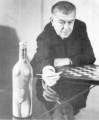
magritte, around 1960Rene Magritte was born in Lessines, Belgium, on 21 November 1898. At the age of twelve he began taking art classes in Chatelet, where he and his family had just moved to. Painting had always seemed "vaguely magical" to Magritte, who was an average student in school. After quitting high school, he enrolled in 1916 at the Academie des Beaux-Arts in Brussels where he followed the classes of drawing, Decorative Painting and Ornamental Composition. Landscapes showing the Sambre river in which his mother had killed herself in 1912, were among his first works.

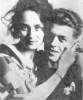
Magritte's best friend at the time was the young poet Pierre Bourgeois, of whom he made several portraits. They became interested in modernity and the Italian Futurists and invited Theo van Doesburg to give a lecture on the Dutch movement 'The Style'. In 1920, Magritte's first Futurist-inspired paintings were exhibited along with works by the painter Pierre Flouquet. Pure geometric abstraction, which had its roots in the Northern countries, seemed too radical to Magritte who began to search for a different pictorial language, this time finding it under the influence of Cubism and Futurism.georgette and magritte, 1920

The year of 1922 meant a lot for Magritte. In 1922 Magritte got married with Georgette Berger, whom he had met at the age of fifteen and met again at in 1920. Magritte was inspired by Georgette and she became his model. He also became friendly with Victor Servranckx, who had developed a very personnel geometric-abstract style. This was the beginning of a new direction for Magritte.

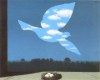
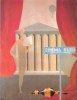
blue cinema, 1925His first really outstanding works date from 1922-1923 and are characterized by Cubo-Futurist reminiscences and the pleasure of a very sensual representation in which women and colors are the dominant elements. He had realized that resorting to abstraction had not enabled hum to 'make reality manifest.' What he wanted was to establish a disturbing relationship between the world and objects. Therefore, toward 1925, he decides "the bather, 1925only to paint objects with all their visible details". By placing them in situations which were unfamiliar to the spectator, he would "challenge the real world". Magritte abandoned the plastic qualities of pictorial art in favor of a more remote, colder style that portrayed images from which all aestheticism had to be banished.

One of the first works to display this change was Nocturne (1925). The work contains element from thethe last jockey, 1926 iconography that Magritte created at the time and which he used throughout his life: the painting within a painting, the bird in flight, and fire, adding to the stage curtain an to the wooden bilboquet. These last two elements are also at the heart of The last Jockey (1926) which, according to Magritte, was a critical milestone in his entry into Surrealism. It gave him a mysterious feeling, an anxiety without reason.The feeling of anxiety, which manifested itself in dark tonalities, lugubrious shapes and mysterious juxtaposition of objects, invaded a large number of works from these years.attempting the impossible, 1928

In 1927 Magritte and Georgette moved to Paris to be closer to where it all happens. He started to take part in the activities of the Surrealists and he becomes friends with Andre Breton. In 1929 he even went to Cadaques to stay with the Surrealists Salvador Dali, Juan Miro and Paul Eluard for a holiday.

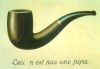
treachery of images, 1929During the same period (1925-1930), Magritte began combining words and images in his paintings. These word-pictures were not mere illustrations of an object or a concept. On the contrary, his work was intended to gently destabilize our mental habits of representation. Magritte elaborated a didactic classification of this type of painting, the simplest which consisted of denying an images through words, or vice versa. The most celebrated example of this is The Treachery of Images (1929): the key of dreams, 1930This is not a pipe since we can not smoke it. It is only a representation of one. Another technique used by Magritte was to represent a familiar object and to attribute to it a name other than its conventional one. Through this gallery of word-paintings, Magritte plays on the discrepancies, paradox, clarity and obscurity of common sense. The question remains as to whether the words actually represent what we think. As a result, the painting becomes a type of language.

the giant woman, 1929-1930Even when he lived in Paris, Magritte did not have a single one-man exhibition. In 1930, the effect of the economic crisis were apparent. His friend Goemans was forced to close his Paris gallery and collectors and galleries were bankrupt. Magritte no longer had a steady income and his relationship with Breton had deteriorated as a result of a mutual independence of mind. Discouraged he returned to Brussels and turned to commercial work.

With the support of a network of friends and sponsors who enabled him to sustain his daily life and to exhibit on several occasions black magic, 1933-1934at the Palais des Beaux Arts, Magritte was able to pull through these difficult years (1930-1940). At the same time he was earning a reputation abroad and his work was being exhibited in one-man shows or in group shows with other Surrealists in London, New York and Paris.

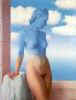
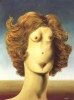
the rape, 1934Magritte shared the Surrealist concept of the power of desire and eroticism to 'change life' and wanted to translate this idea through unconventional images. He continued involving metamorphosis in his work. In Black Magic a naked woman leaning on a rock gradually merges into the blue sky. The painter was, nevertheless, distrustful of the obvious seduction of 'pretty colors'. In The Rape he even pushed it to the point of obsession with the features of a woman's face replaced by sexual attributes: breasts, belly button and pubic hair. To avoid a scandal this painting was hidden by a velvet curtain at the Minotaure exhibition in Brussels.the return, 1940

In 1940, Magritte was going through a crisis resulting from the German Occupation, his precarious financial situation and his dissatisfaction with his painting. From then on, he treasure island, 1942decided that a feeling of pleasure and an atmosphere of happiness had to predominate over the sense of anxiety and suffocation which had previously inhabited his work. In order to show the 'bright side of life', Magritte first thought about changing his iconography and began to paint the leaf-birds which we see in two works from 1942, Treasure Island and The Companions of Fear.

the favorable signIn 1943, he was struck by a reproduction of Pierre Auguste Renoir's Bathers which led to a decisive transformation in his work. Enticed by the sensuality of the colors, he opted for a more luminous palette. While continuing to draw objects and figures with the meticulousness for which he was known, he added to them a touch clearly inspired by Impressionism, unleashing color in new, warmer and more cheerful tonalities. Magritte called this period his 'Sunlit' period.

megalomania, 1948Alexander Iolas, who became Magritte's principal dealer in the United States, successfully exhibited the artist's work in New York in 1947. Iolas therefor suggested that Magritte forgethe domain of arnheim, 1949t Renoir and focus his production on images which overwhelmingly appealed to the public, like Treasure Island. Obligated to come to terms with the necessities of life, Magritte created new combinations out of old images. Megalomania ( 1948) reveals similarities with The Marches of Summer (1938-1939): a female torso (now in three parts), weightless cubes, blue sky with clouds and a parapet. More works followed. For example The Domain of Arnheim (1949), was originally painted in 1936.

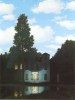
the dominion of light, 1954Magritte enjoyed the game of juxtaposing and manipulating motifs. An image could exercise such powers of seduction that the painter felt compelled to reproduce it many times. Rather than falling intothe battle, 1959 repetitive indifference, he devoted himself to particularly evident in The dominion of Light (1949), an evocation of the simultaneous presence of day and night, a magnetization of the contradictions dear to the Surrealists. There are sixteen versions of this work.

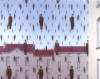
Among the works by Magritte which, beginning in the mid-1950's, definitively ensured his international recognition, one was the subject of extraordinary infatuation. In Golconda (1953), Magritte brilliantly united different motifs from his repertory: small men in overcoats and bowler hats float weightlessly in a blue sky in front of facades of houses.golconda, 1953 Present since 1927, this bowler-hatted figure finally finds his true dimension. He becomes sels.